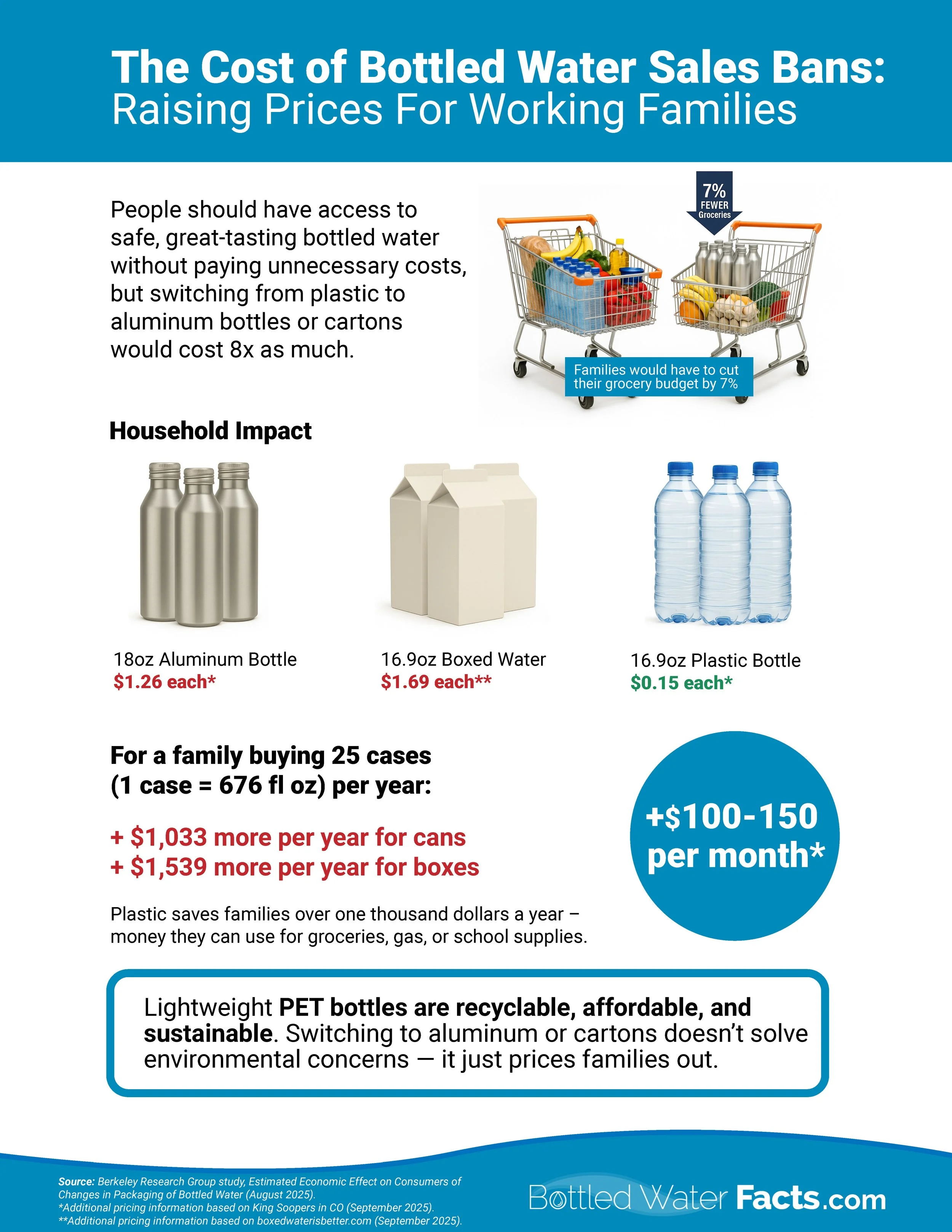
The Cost of Bottled Water Sales Bans
A study from the Berkeley Research Group reveals what happens to the price of bottled water when we swap plastic bottles for aluminum cans.
The study, Estimated Economic Effect on Consumers of Changes in Packaging of Bottled Water from Plastic Containers to Aluminum Cans, by Tom Campbell, Ph. D. and Thomas Gill, isn’t just about water, it’s about how a change in packaging could ripple through your grocery bill. As the authors explain,
“Substituting aluminum cans for single-serve plastic containers will substantially increase the amount spent by individual consumers in the US on bottled water.”
They start with a concept called “elasticity of demand” for bottled water which is just a fancy way of saying how much less you’d buy if the price goes up. The researchers studied data from around the United States including Washington, Oregon, Idaho and several cities in California to figure out how sensitive we are to these price changes. Their conclusion?
“If bottled water must be provided in aluminum cans rather than plastic bottles, the higher cost will be passed along in part to the consumer. In the short run this pass along will be higher; in the longer run, consumers will adjust somewhat. Even in the longer run, however, the increase in the expenditure consumers will make for bottled water will grow to almost three-fold of its current level.”
Here’s where it gets interesting: aluminum cans are way pricier to produce than plastic bottles—about nine times more per ounce, according to data from three major water bottling companies. The study found that this switch would significantly increase what we spend on bottled water by a jaw-dropping 405% in the short term, settling down to a still-hefty 174% over time. That means your grocery bill could climb by over 7% right away and 3% in the long run.