
The Guardian’s Coverage Highlights Microplastic Science Scrutiny
The Guardian's recent coverage of microplastics research marks a welcome news media shift toward greater scientific scrutiny. As we've been monitoring at Bottled Water Facts, news outlets have frequently cited studies claiming widespread micro- and nanoplastics (MNPs) in the human body—often linking them to serious health risks. This kind of coverage has been fueling broader narratives against single-use plastics, including bottled water.
This is why we we're glad to see two recent pieces from The Guardian that acknowledge significant questions about much of this research.
The start of a positive trend?
In a January 13 article titled “‘A bombshell’: doubt cast on discovery of microplastics throughout human body,” The Guardian reports on growing scientific criticism of high-profile studies purporting to find MNPs in human organs. Some scientists are now calling out serious methodological issues, including contamination risks, false positives, and inadequate lab controls. One expert, Dr. Dušan Materić, at the Helmholtz Centre for Environmental Research in Germany, didn't pull his punches when critiquing one study, which he argues falsely classified fat in the brain as plastic particles:
“The brain microplastic paper is a joke. Fat is known to make false-positives for polyethylene. The brain has [approximately] 60% fat.” Polyethylene is used to make PET plastic bottled water containers.
The Guardian piece also highlighted a recent analysis that listed 18 studies that did not consider the risks of false positives, with critics noting that concentrations reported are often "completely unrealistic" or biologically implausible. While everyone agrees that we should minimize plastic pollution, the article stresses that faulty evidence could lead to misguided policies, echoing concerns we and at least one other science writer have raised about overhyping risks without robust proof.
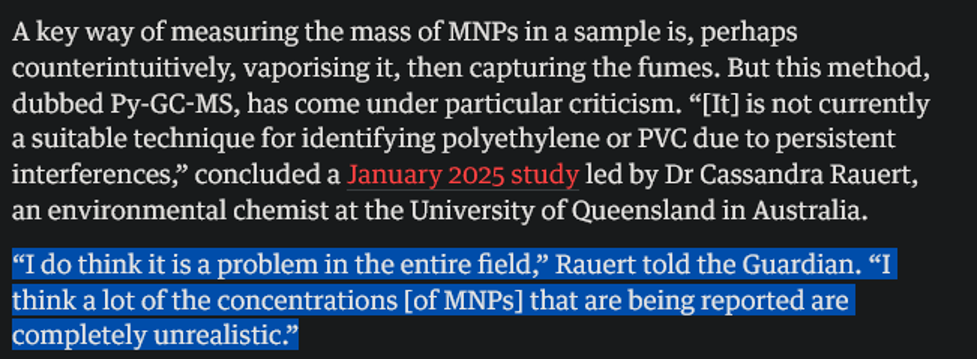
This important message is reinforced in The Guardian's January 18 editorial, “The Guardian view on microplastics research: questioning results is good for science, but has political consequences.” It describes systemic problems in the young field—noting one scientist has argued that possibly half of high-impact papers suffer from methodological issues—and argues for wider consultation, more peer review, and stronger evidence. The piece praises self-correction as healthy for science and calls for caution in reporting until research standards solidify.
These two pieces back up what experts have been saying: many claims about pervasive microplastics in the body stem from novel methods with shorter track records, rather than robust scientific evidence.
For the bottled water industry, these methodological issues underscore a long-held concern: that broader narratives against packaging have outpaced the science. We have argued that the broader plastic packaging narrative has leaned heavily on microplastic fears. As our earlier post on The Guardian's own questionable narratives on this subject points out, such reporting has exaggerated threats, paid insufficient attention to the benefits of bottled water, and overlooked FDA statements that there's not enough scientific evidence to draw actionable conclusions.
Exposure doesn't automatically mean harm, and conflating detection with danger has driven policy pushes against bottled water without solid evidence.
Conclusion: Kudos to The Guardian
Kudos to The Guardian for highlighting flaws in questionable microplastic research. This action both builds this paper’s credibility and protects against misinformation.