
The Cool Down's Misleading Campaign Against Bottled Water
Americans have enjoyed bottled water for decades. In all those years, consuming bottled water has resulted in massive reductions in calorie intake and improved health and hydration. Bottled water is strictly regulated at the federal and state level, which helps ensure its safety and quality. Alongside its healthy hydration benefits, bottled water is most often packaged in 100 percent recyclable PET plastic, making it a perfectly sustainable option for consumers who want to minimize their environmental footprint.
In recent years, quasi news outlets like The Cool Down have amplified unfounded concerns about the materials used for bottled water containers, portraying it as a cause of hidden harms. A review of The Cool Down’s archives reveals a sharp, deliberate and unscientific escalation in coverage of bottled water as a specific environmental and health threat. The problem is amplified because The Cool Down's misleading content is regularly boosted by news aggregators like Yahoo!—where the site's co-founder Anna Robertson was once an executive and producer.
The bottled water attack begins
From the site’s launch in July 2022 through all of 2023, virtually no headlines centered on bottled water; stories touching on the topic treated it only as one subset of broader plastic pollution and recycling discussions. But this shifted in early 2024, with the site suddenly keen to amplify the supposed risks of plastic exposure. In 2025, the focus intensified dramatically: the outlet published roughly 313 articles mentioning bottled water, including approximately 25 that led with it as the primary subject.
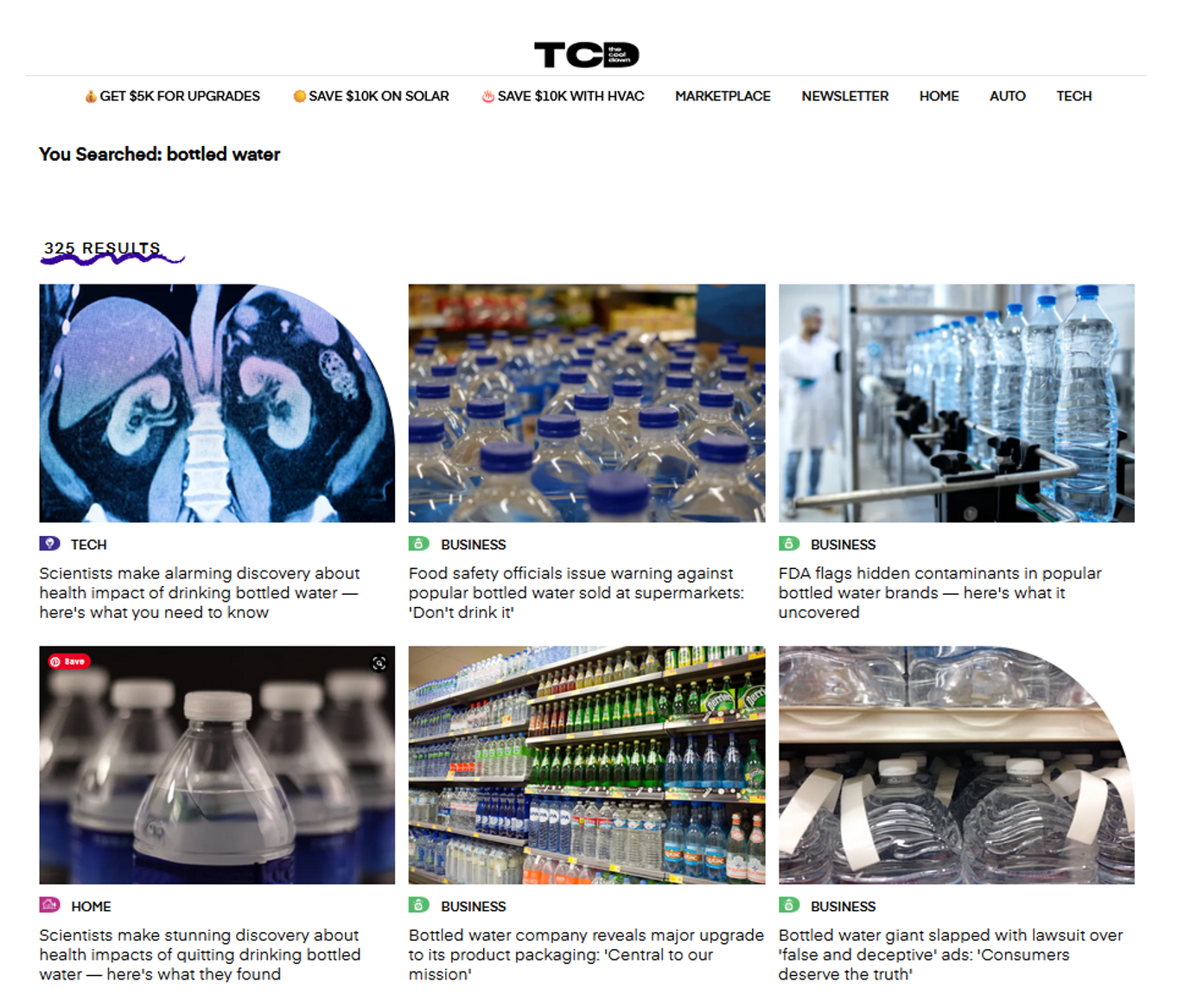
The pattern marks a clear editorial pivot to a sustained, hyperbolic campaign framing bottled water as an urgent public-health risk. By amplifying preliminary findings on microplastics while downplaying regulatory safeguards and the recycling progress, The Cool Down is proliferating misinformation about trendy health scares. When their content is picked up by news organizations such as Yahoo! News, agenda-driven content suddenly becomes taken as legitimate journalism. And when these articles play well, it is incentive for The Cool Down to increase similar types of content.
But here is the real concern: Consumers are being grossly misinformed about a very popular healthy hydration product that is essential to everyday life. And discouraging bottled water consumption is not in the public interest.
Let's consider a few examples of the site's troublesome bottled water coverage so you can see how consumers are being manipulated.
An "alarming" discovery
In an October 2025 story titled "Scientists make alarming discovery about health impact of drinking bottled water," the site dramatically overstates the evidence in question. The piece sensationalizes a single study to suggest microplastics containing the chemical Benzo[a]pyrene cause kidney damage.
But this conclusion runs headfirst into several critical problems. First, the material in question is not used to manufacture PET plastic water bottles. Right out of the gate, the researchers are investigating the wrong material. Next, the study’s exposure levels were roughly 20 times higher than real-world human exposure.
Finally, major reviews from the World Health Organization (WHO) and European Food Safety Authority (EFSA), continue to find that no reliable evidence of human health risk exists with microplastic exposure. The FDA agrees, concluding in 2024 that it "is not aware of scientific evidence that would support consumers being concerned about the potential level of microplastic or nanoplastic contamination in food, including bottled water." A single study looking at one chemical in no way challenges this international expert consensus.
Studies that prove nothing
In September 2025, The Cool Down joined a chorus of media outlets in warning about exposure to microplastics based on a misunderstood review article. "Study finds side effects of drinking from plastic water bottles grossly underestimated: 'Not something that should be used in daily life,'" The Cool Down's headline declared. The story sensationalizes a meta-analysis of 141 studies to claim that daily use of these bottles could expose consumers to thousands of plastic particles annually.
But The Cool Down again overstates the evidence, which is clear if you just read the review article. Like the WHO, EFSA and FDA, this review didn't come close to the media's hyperbole. "[T]here are limited studies specifically focused on single-use plastic water bottles and the different laboratory conditions under which they should be tested," the authors noted. Their conclusion in the following sentence was unequivocal: "Additionally, the number of samples tested in existing studies is often very limited, which hampers the ability to draw definitive conclusions [our emphasis]."
The Cool Down's warning against daily bottled water consumption to avoid "chronic toxicity" ignores the review's important qualifications. If existing studies prevent scientists from drawing definitive conclusions, then it's inappropriate for media outlets to draw conclusions as well.
Blood pressure facts and myths
The Cool Down's August article "Scientists make concerning new link between plastic water bottles and substantial health risks – here's what you need to know" breathlessly promotes a tiny pilot study of healthy volunteers who reported switching from bottled to tap water and experienced inconsistent blood pressure reductions, claiming this links microplastics from bottled water to hypertension and cardiovascular disease.
Yet this sensationalism crumbles under scrutiny. The study's minuscule number of participants, literally only eight people, prevents the researchers from saying anything meaningful about microplastics, bottled water or any other topic for that matter. To understand the health effects of any behavior, you have to study it in large populations for a long time; measuring the blood pressure of eight people for a month doesn't demonstrate anything "concerning" about any product.
The authors of the pilot study were helpfully frank about the limits of their results. "To confirm this hypothesis, a larger sample of male and female participants must be examined, ideally with the monitoring of plastic concentration in the blood."
Conclusion
When it comes to ominous claims about the supposed dangers of plastic, skepticism is the order of the day. A website like The Cool Down—with a business model built on affiliate marketing—has not objectively reported the facts about bottled water. Indeed, the site's new owner, green energy company Palmetto, knows exactly what it paid for: a website whose "readers will have direct access to the impactful, affordable, clean home energy solutions they’re looking for through the Palmetto home energy marketplace."
They amplify supposed threats to public health without backing up the claims, then sell their readers what they want them to see. Buyer beware.