
The Activist Campaign to Eliminate Bottled Water
The Activist Campaign to Eliminate Bottled Water
Bottled water has become one of the primary targets in a broad-based, multi-organization activist campaign aimed at reducing consumer choice and eliminating large swaths of consumer products and packaging. A group of Non-Governmental Organizations (NGOs) with roughly $1 billion in overall foundation support have tried to paint popular consumer products such as bottled water as a threat to the environment. These NGOs push for extreme policies like outright bans on the sale of bottled water as a major component in their broader effort to end the use of plastic generally. Such bans or efforts to heavily restrict bottled water strip away consumer choice, convenience, affordability, and yes, even access to good water.
The pattern is impossible to ignore: the attacks on bottled water aren’t organic, local, or consumer-driven — they are the product of a remarkably small circle of national foundations and professional activists who treat everyday products as ideological chess pieces. Understanding that bottled water is being targeted not because it’s actually harmful (because it isn’t), but because it’s an easy symbol for a much larger activist project, makes the stakes clear. This is a campaign built by insiders with ample resources, not by ordinary people with ordinary needs.
And that matters. Because when well-funded activists succeed in narrowing consumer choice, restricting access, or making simple conveniences more expensive, it’s not foundation staffers or billionaire donors who pay the price — it’s you. Ordinary Americans lose affordability, lose flexibility, and lose the freedom to decide what works best for their families.
The Deep-Pocket Network Leading the Attack
Backed by a handful of large and influential foundations, a nearly $1 billion network has emerged that both drives large sums to existing NGOs and helps establish new, free-standing groups dedicated to specific aspects or targets of anti-plastic activism. As discussed below, the explicit goal of these groups is the elimination of single-use materials, including the recyclable plastics used in bottling water.
In just five years, a tightly knit network of 11 large foundations—including the Walton, Packard, Hewlett, and Tides Foundations; the Bloomberg Philanthropies; and the Foundation for the Carolinas—has donated close to $1 billion to 13 high-profile environmental NGOs. Funding is primarily routed through legacy environmental outfits like the Sierra Club, Greenpeace, and Natural Resources Defense Council (NRDC) among others. In turn, these groups spin off a number of smaller organizations operating at the regional, state, and even county levels. They then work with media outlets and content creators to push for material bans and other restrictions in the US.
Crucially, the foundations themselves only rarely engage in direct advocacy or activism. Instead they disburse grants to the activist groups that mount and execute anti-plastic campaigns. When this model "succeeds," it means that a small but vocal group of activists with niche beliefs can reduce consumer choice and make simple conveniences both more expensive and harder to come by.
Here are some specifics:
The Park Foundation states explicitly in its environmental mission its aim for “reduced consumption of bottled water” and “strong and enforced water policies.” Park disburses tens of millions of dollars in multi-year grants to groups like NRDC, Greenpeace, and Environmental Working Group, which spearhead campaigns against the use of bottled water. In October 2025, for instance, the NRDC—which has received hundreds of thousands of dollars from the Park Foundation—published a "guide" that called into question existing bottled water regulations, cast doubt on the safety of the product, and encouraged the use of expensive filters that may not even be necessary.
Since 2010, the Park Foundation has awarded over $1.5 million in grants to advocacy groups to lobby against bottled water and promote tap water. Key organizations and campaigns include:
Clean Water Fund (Washington, DC) The total awarded from 2020 to 2024 amounts to $825,000. The purpose is “national drinking water programs,” which includes promoting tap water alternatives and amplifying claims about bottled water’s alleged environmental and health risks. This comprises $250,000 in 2024; $300,000 in 2022; $150,000 in 2021; and $125,000 in 2020.
Food & Water Watch The total awarded between 2020 to 2024 amounts to $1,020,000. This includes general support and funding for its Public Water for All campaign, which promotes anti-bottled water positions, including warning about alleged “corporate capture” of water resources and purported environmental impacts of packaging materials.
Story of Stuff Project In 2024, the foundation awarded $50,000 to the Story of Stuff Project. In 2021, they were awarded $35,000. These grants helped fund the Unbottle Water & Bring Back Refill campaigns, which involved direct anti-bottled water messaging and refill station promotion. They have also been awarded $125,000 since 2021 for their Troubled Water campaign, which has targeted private companies for merely buying and owning natural resources that supply quality drinking water.
Bloomberg Philanthropies, in its “Beyond Petrochemicals” initiative, claims sensationally that the beverage industry has an "addiction" to bottles that is "poisoning people" and attempts to link bottled water to climate change. Both of these strange ideas are simply not true.
Bloomberg Philanthropies disburses nine-figure sums to groups including Oceana, Sierra Club, and Beyond Plastics, which are all overtly hostile to bottled water. For example, Beyond Plastics declares that water bottles are responsible for a whole litany of alleged harms up to and including "poisoning our air when they're burned in incinerators" instead of responsibly recycled or disposed in the way intended. The group endorses tap water to replace bottles and calls on supporters to "Urge your local airport, government, school, or business to follow San Francisco International Airport's lead" and "ban the sale of single-use plastic water bottles on their premises and ensure that there are enough water filling stations to keep everyone’s thirst quenched."
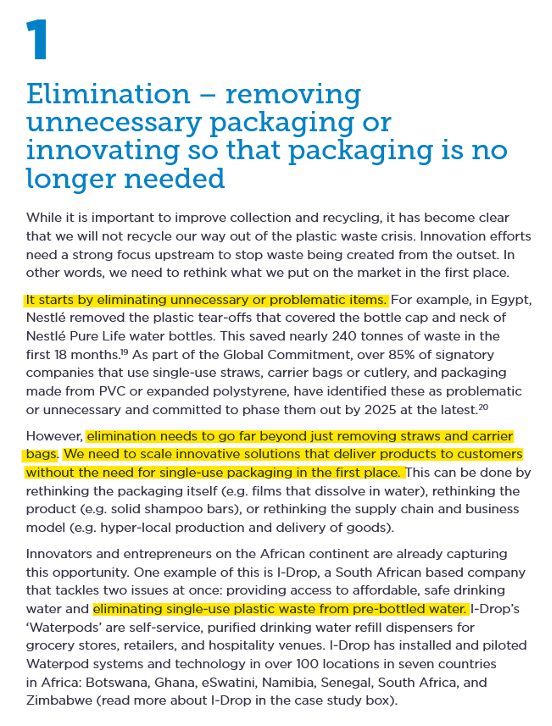
The MacArthur Foundation's anti-plastic disposition is also clear, urging in a 2021 report that single-use packaging be eliminated entirely. Later in the same document, MacArthur touts refillable water stations as an alternative (p 8 of the report):
There are other foundations that, while they do not explicitly call for the end of bottled water consumption, oppose the materials that go into plastic water bottles, an essential part of the same supply chain.
The Walton Foundation for instance provides significant financial support for Oceana, a major activist player in the campaign against the material used in water bottles. Oceana describes Walton as a donor to its campaign "to pass local, state, and national policies that reduce the production and use of" materials like the PET used in water bottles, "and move toward refill and reuse systems." The campaign calls for policies that eliminate single-use plastics:
"These policies often focus on the most common waste items found in worldwide beach cleanups: utensils, food wrappers, plastic beverage bottles, plastic bottle caps, plastic grocery bags, other plastic bags, straws/ stirrers, plastic containers, plastic lids and foam takeout containers. Since all of these items are used once and then thrown away, a logical starting point is to target single-use plastic items."
The Tides Foundation similarly speaks through its grantees, with the NGO People Over Plastic thanking Tides for its WE LEAD grant, which "has been an amazing support to take on...plastic pollution, climate change, and human health (p 19).”
Another Tides grantee, Corporate Accountability International, calls for individuals to cut bottled water purchases, schools and other institutions to remove bottled water vending machines, and governments to outlaw private ownership of fresh water sources. Over the last decade, Tides has donated almost $50,000 to Corporate Accountability International.
The Packard Foundation, one of the largest donors in the network, boasts about its refusal to stock single-use plastics in its own facilities:
"Today, we don’t allow single-use plastic at events or in our staff kitchens ..."
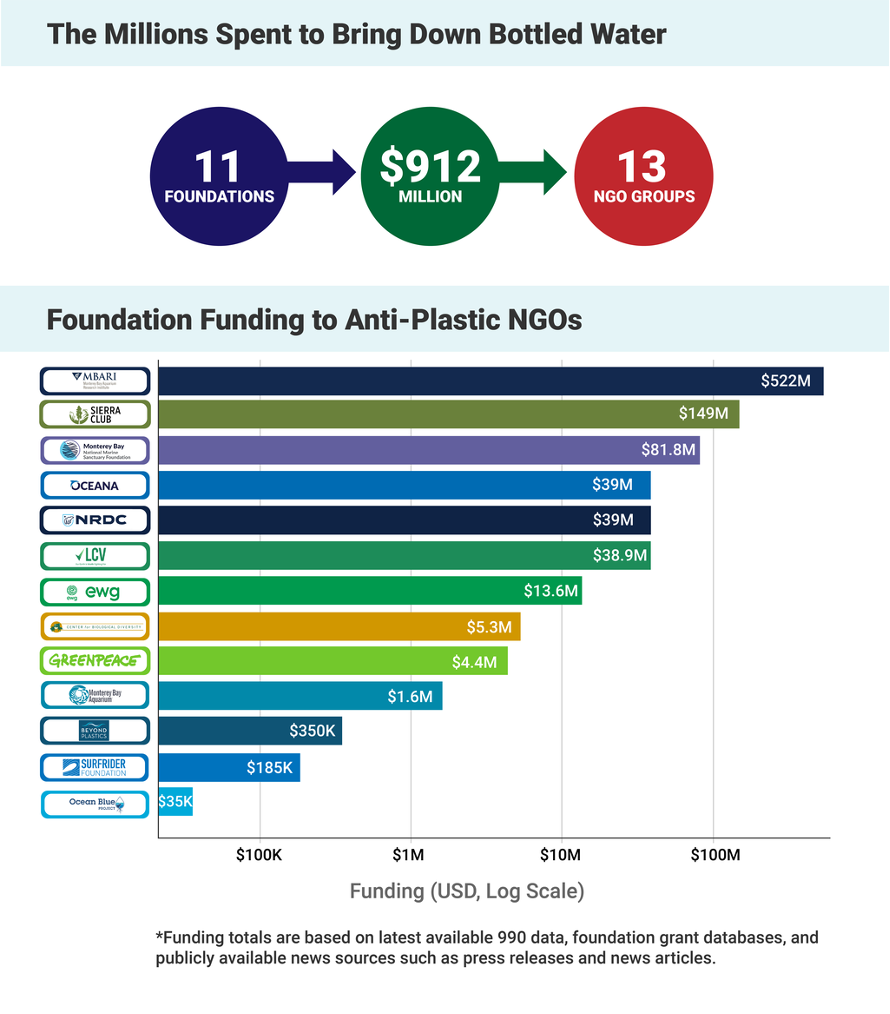
View the funding network in more detail here
Coordinated Efforts
Although these various entities often act independently, the work of groups like the Plastics Pollution Coalition (PPC), an "advocacy organization that collaborates with...organizations, businesses, and individuals to create a...world free of plastic pollution," shows well their actions can be coordinated. That collaboration includes overall strategic planning, timing, tactical execution, and arranging the various elements like experts, research and lobbying.
Notably, PPC counts several of the foundations discussed above as key donors. Since 2020, these foundations have donated tens of thousands of dollars to the PPC via the Earth Island Institute. The Plastic Pollution Coalition is a "project" of the Earth Island Institute, which acts as its fiscal sponsor and disperses foundation funds to PPC. The Park and Marisla Foundations are typical examples.
Park Foundation
2023 - $30,000, “Plastic Pollution Coalition general operating support”
- $30,000, “Plastic Pollution Coalition general operating support”
2022 - $25,000, “Plastic Pollution Coalition general operating support”
Marisla Foundation
2021 - $40,000, “General Support for Plastic Pollution Coalition”
2020 - $40,000, “General Support for Plastic Pollution Coalition”
PPC has aggressively attacked consumer water brands as part of its collaborative work. For instance, Earth Island Institute and PPC sued one company several years ago over allegations it used "unfair and deceptive business practices to promote their products and recycling capabilities."
Funding Favorable Media Coverage
In addition to lobbying for restrictions or sales bans, orchestrating protests, and leading litigation against the bottled water industry, this funding network is even expanding into bankrolling friendly media coverage. Most notably, the same foundations that finance the anti-plastic network also provide environmental journalism grants to major media outlets. Those financial arrangements with news media enable coordinated, focused publicity for the planned sequence of events driven by the network.
For example, the Walton Foundation has donated several million dollars to the Associated Press (AP) in recent years to support the news outlet's "sweeping climate journalism initiative." The AP has disclosed this funding in its coverage of nanoplastic particles in bottled water, and publicly credited Walton for supporting its water issues reporting.
But this is only one example of Walton's support for environmental coverage. As Philanthropy News Digest reported in 2023:
"The [Walton] foundation also supports environmental journalism through the Society of Environmental Journalists (SEJ), Planet Forward, Report for America, the University of Missouri, NPR, the Good Energy Project, and other journalism, nonprofit, and academic organizations that provide information on the causes and solutions for climate change."
This media collaboration is transparently designed to shape consumer opinion by managing the public discourse around the products the network targets. By rewarding anti-industry perspectives on these issues, these grants stack the deck against both industry and consumers in favor of activists, and preclude a meaningful and substantive conversation on the merits.
Although the network outlined above publicly opposes bottled water and the materials that make it possible, some organizations are more abrasive than others. The Sierra Club provides perhaps the most outrageous example in a blog post titled “Reduce Your Carbon Footprint: Say NO to Bottled Water” that recklessly compares ordinary bottled water advertisements to cigarette marketing like “the Joe Camel ads that hooked kids on cigarettes."
Other activist NGOs have amplified similarly hostile messaging that gets both the economics and the value proposition of the bottled water industry entirely wrong. “Gentle reminder that bottled water companies don’t produce water, they produce plastic bottles,” Greenpeace wrote to its Facebook followers, implying that companies that provide safe clean and healthful drinking water are "just another way for Big Oil to make money."

A typical example of anti-bottled water advocacy.
This rhetoric is not only factually incorrect but also carries serious consequences. It can harm public health in several concrete ways, from reducing overall water intake to driving a switch to calorie-dense sugary beverages.
Decide For Yourself
The next time you see headlines or social campaigns attacking bottled water, remember to ask who is pushing the narrative, why they’re doing it, and whose interests are actually being served. Your purchasing and consumption choices should be shaped by your own needs — not by a coordinated effort to make those choices disappear.